June 4, 2026
IMPORTANT:
Reporting Requirements from Vermont Fish and Wildlife
|
|
| As a reminder, continued participation in the TIC program requires that you complete and submit the brief year-end survey administered by VINS. The Vermont Fish & Wildlife Department maintains records of all stockings throughout the state to track where hatchery-raised trout are distributed to Vermont’s waterways. VFWD Fisheries Biologists regularly review these records, which serve as a reference for current and future researchers who study our wild trout populations. Including the number of fry your school releases and the release location in this database is critical, given the TIC program’s extent. Thank you for bringing this wonderful program to Vermont’s youth, and good luck with your project. |
|
|
May 14, 2026
Reminder of Reporting Requirements from Vermont Fish and Wildlife
|
|
| As a new requirement, continued participation in the TIC program requires that you complete and submit the brief year-end survey administered by VINS. The Vermont Fish & Wildlife Department maintains records of all stockings throughout the state to track where hatchery-raised trout are distributed to Vermont’s waterways. VFWD Fisheries Biologists regularly review these records, which serve as a reference for current and future researchers who study our wild trout populations. Including the number of fry your school releases and the release location in this database is critical, given the TIC program’s extent. Thank you for bringing this wonderful program to Vermont’s youth, and good luck with your project. |
|
|
May 7, 2026
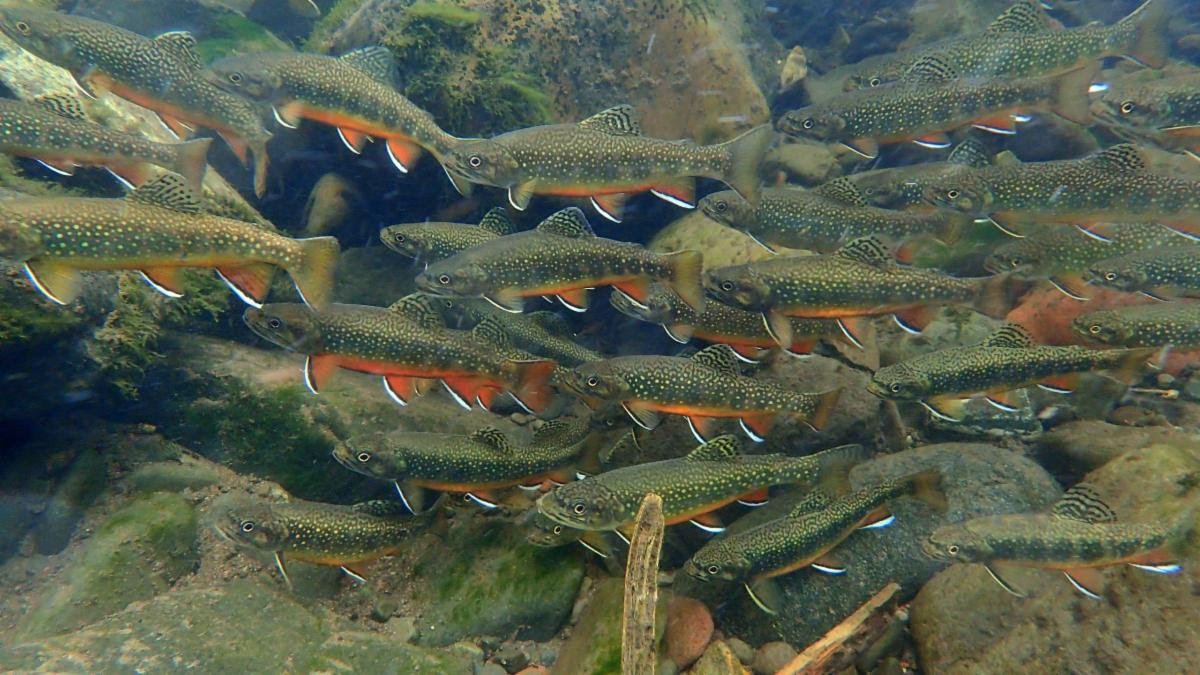
| Dear Trout Teachers,
Catching your trout to put them into the transport container can be surprisingly challenging. The first time you dip your net into the tank, you’ll probably catch quite a few, but with each successive attempt, the fish will become more skittish and better at evading your net.
Here’s some advice for how to make the tank-to-cooler transfer.
- You will want two nets, one large and one small (photo below), and three containers: the original tank, your transfer cooler or bucket, and a third container to count the fish from each netting before moving them to the cooler/bucket.
- Ideally, at least four people will collaborate on this project: two “wranglers” who work together to net the fish and put them in the third container, and two “counters” to count the new additions and transfer them to the cooler or bucket you’ll be using.
- Turn off the chiller, filter, and aerator, and remove them from the tank. Also, remove any rocks or tank “furniture” you may have added.
- Use a ruler or other straight-edge to push the gravel down to one end of the tank.
- Remove half of the water from the tank.
- Add some of that tank water to your transport container. If you’re using a cooler, fill about 1/3; if using a bucket, fill about 1/2.
- Start with several cups of water in your third container.
- The fish wranglers should net several fish (any number up to about seven— more than that will be hard to count), put them into the third container, and hand the container to the counting team. (Having two “third containers” would expedite the process.)
- The counters should count the new additions, record that number on a whiteboard or clipboard, pour the new fish into the cooler, put some cooler water back into the third container, and hand that container to the wranglers.
- Keep netting and counting.
- Netting the last fish can be challenging. The wranglers will have to work together, sometimes “driving” the last holdouts toward the big net.
- Even when you think you’ve got them all, check again, and again. There’s often at least one small fry hunkering down in the gravel. Stirring the gravel up a bit may allow you to spot them.
- If there’s any chance the water in the cooler will slosh around on the trip to the river, strap the cooler closed or fasten it with rope or duct tape.
|
|
|
Getting Trout to Your Release Site
|
|
| Depending on how far you have to travel and how much time will transpire before you actually release your fry, a container for transporting your fish to the release site might be very simple or a bit more complicated.
If your target stream is only 15 or 20 minutes away AND you plan to release your trout soon after arriving at the stream, you can probably use a conventional 5-gallon bucket (with a top). If it’s a hot day, you should probably freeze a couple of plastic bottles of tank water and add those to the bucket to prevent the water temperature from rising.
If you have a longer trip or plan to release your trout after a couple of hours of in-stream fun, it may be desirable to transport fish in an aerated cooler.
Here are instructions for modifying a standard 48-quart cooler for use on Release Day. (This could be done more simply, but I chose an approach that would allow our family to still use the cooler for picnics.) Here are photos of the modified cooler with a battery-powered aerator and digital thermometer. |
|
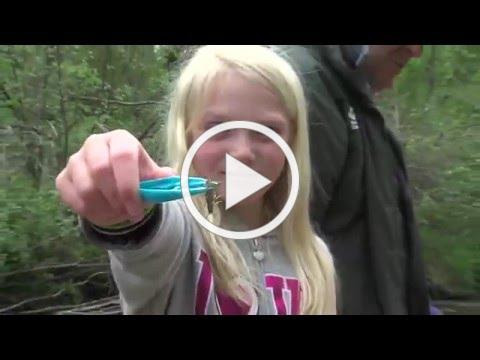
| This video of Release Day with former Mary Hogan School teacher Steve Hogan shows a creative way to keep trout in the stream for hours by fastening netting inside a milk crate. That’s a great way to do it!! |
|
| While these tips and tricks are helpful, don’t forget to (re)read Chapter 9! |
|
| As exciting and fun as Release Day is for most schools, it can be a bittersweet time for a couple of reasons.
For one, every year, a few schools lose all their fish and have nothing to release. (They could, of course, still spend a few hours at the brook where they had intended to release the fry and do everything else, such as collecting macroinvertebrates, studying the stream’s characteristics and habitat, playing “Macro Mayhem,” etc.) Sometimes it’s obvious why all the fish died, but every year we’re left with at least a couple of mysteries. The teacher and the students seem to have done everything right, and yet there was a massive die-off. At best, we have hypotheses and guesses about what might have gone wrong, but it’s frustrating not to have a definitive explanation.
The other cause of bittersweet feelings is simply that, after living with and caring for these increasingly beautiful creatures for six months, we miss their presence when we return to the classroom on the first school day after their release. |
|
| One way to distract yourself and your students from those sad feelings is to dive into the process of cleaning the tank and its equipment and packing it away until next year. (See Chapter 10 of the Manual.) It’s so much easier to clean the TIC components now rather than waiting to do it in November after the grime and calcium have hardened in place for half a year.
While most Vermont TIC schools have what are called “drop-in” chillers (which are easy to clean by a process described in the Manual), some have “flow-through” chillers. These pump water out of the tank and through a mini-refrigerator and then back into the tank. Cleaning these requires a different process, which you’ll find described in this document. |
|
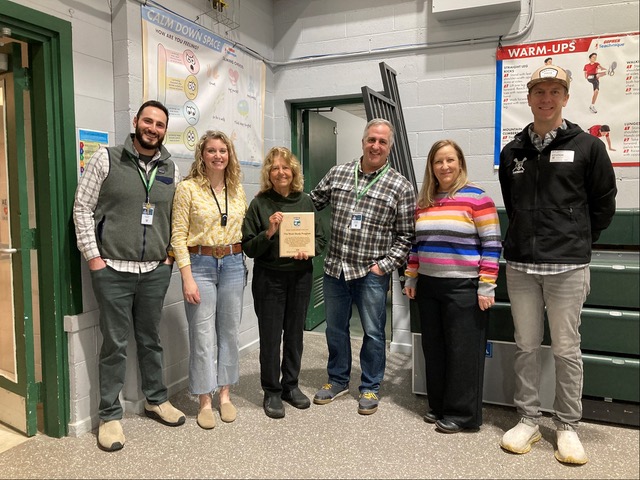
| The Stowe Elementary 5th-grade team has been recognized as the Stowe Conservationist of the Year! Each year, the Stowe Conservation Commission recognizes a local organization or individual as Conservationist of the Year. This year, the Commission is recognizing the 5th-grade teachers at SES in honor of their water quality and river study program. Their work teaching students about river health, ecology, and stewardship helps instill an appreciation for the natural resources that are fundamental to our community’s well-being. It is estimated that 1,400 students have engaged in their river study over the years of this long-standing curriculum. Congratulations! |
|
| Photo L to R: 5th grade teachers Ray Kramer, Maddy Hulbert, Neidi Suursoo, and Mike Rapoport, and Stowe Conservation Commission members Cathy Gott and Ryan Krukar |
| Thank you, as always, for being part of our program!
– Jim Armbruster
Lead Biologist
Center for Field Research
Vermont Institute of Natural Science
802.359.5000 ext. 222
jarmbruster@vinsweb.org |
|
Reminder of Reporting Requirements from Vermont Fish and Wildlife
|
|
| As a new requirement for the program, continued participation in the TIC program requires that you complete and submit the brief year-end survey administered by VINS. The Vermont Fish & Wildlife Department maintains records of all stockings throughout the state to track where hatchery-raised trout are distributed to Vermont’s waterways. VFWD Fisheries Biologists regularly review these records, which serve as a reference for current and future researchers who study our wild trout populations. Given the extent of the TIC program, it is critical that information on where your school releases its fry and their number be included in this database. Thank you for bringing this wonderful program to Vermont’s youth, and we wish you good luck with your project. |
|
|
April 8, 2026
The Stowe Elementary 5th grade team has been recognized as the Stowe Conservationist of the Year! Each year, the Stowe Conservation Commission recognizes a local organization or individual as Conservationist of the Year. This year, the Commission is recognizing the 5th grade teachers at SES in honor of their water quality and river study program. Their work teaching students about river health, ecology, and stewardship helps instill an appreciation for the natural resources that are fundamental to our community’s well-being. It is estimated that 1400 students have engaged in their river study over the years of this long-standing curriculum. Congratulations!
Photo L to R: 5th grade teachers, Ray Kramer, Maddy Hulbert, Neidi Suursoo, Mike Rapoport. Stowe Conservation Commission members, Cathy Gott and Ryan Krukar
April 1 ,2026
| Trout in the Classroom
April Updates: Stream Monitoring, Macro Studies & Earth Day |
|
| Dear Trout Teachers,
April is here, and that means it’s time to get your students outside and into the stream. This month’s newsletter covers everything you need to know about macroinvertebrate collection, from monitoring water temperatures to assembling your collecting kits, so your class can make the most of Release Day and beyond. |
|
| It is a good idea to urge your kids to get out there and start monitoring the local streams. Stream temperatures can change quickly at this time of year and will vary across the state depending on air temperature, location, elevation, and time of day. When you take the temperature matters. If you take the temp at 8:00 am after a cold night, the temperature might be six or seven degrees cooler than it will be at 6:00 pm after a warm, sunny day. |
|
| Many TIC programs engage their students in stream studies, both during the school year and on Release Day. One of the most popular in-stream activities is collecting and classifying macroinvertebrates and then using the macro data to calculate the stream’s “biotic index” as a measure of its health. Because some macros are more sensitive to pollution than others, their presence is a good indicator of stream health. (There are links to charts below).
To collect macros, a net of some sort is needed. Commercial nets – usually a rectangular or D-shaped net attached to a long handle – are available but can be expensive. Links are provided below to two examples: the “student” version costs $62; the “professional” version costs $340. |
|
| Another option is a “kick screen.” A kick screen is essentially two vertical sticks with nylon netting attached to the sticks. Here’s a commercial kick screen that costs $55: |
|
| Kick screens are also easy and inexpensive to make. You’ll need a six-foot tomato stake and 36″ of nylon screening (24″ wide), both available at most hardware stores. Cut the stake in half, sharpen one end of each piece, and staple or tack the screening to the bottom of each stake, leaving about two inches of stake below the screening. You can likely make five kick screens for under $10. After a busy Release Day, they may occasionally need minor repairs.
Pictured below is a kick screen made by Joe Mark, along with students searching for bugs and other creatures on the screen. The white plastic dish pan below the kick screen is where students can transfer the macroinvertebrates and other critters. |
|
|
After your students have caught macros, what do they do with them?
|
|
| If you’re planning a macro collecting/classifying activity, you’ll want to assemble one or more collecting kits. If you choose to create student groups of four or five kids, each under the supervision of an adult volunteer, you will need a kit for each group. None of these items was expensive, and all, with the possible exception of the pipettes, should be available locally.
Contents of collecting kit
- Clear plastic box (for examining macros; this can also be used to flush macros from the kick screen into the wash basin)
- Two small containers with covers (for saving distinguished specimens long enough to share with classmates; I got the containers for free from a fast-food restaurant)
- Two larger containers (probably designed for a pint of potato salad) with covers (for examining and sharing macros with others; obtained for free from a super market)
- Small plastic magnifying glasses
- Tools for transferring macros from kick screen/net to containers (shown below: two tweezers, two plastic artist pallet knives, one plastic spoon; artist pallet knives were purchased at a Michael’s arts and craft store)
- Plastic artist paint tray (for sorting and separating different macro specimens from each other; also bought at Michael’s)
- Two “guppy nets” (available wherever they sell baitfish, especially for ice fishing)
- Two pipettes (for siphoning/picking up tiny macros; plastic eyedroppers could also be used for this purpose)
- Small ruler with metric scale
- Plastic-laminated macroinvertebrate identification charts (more on these later)
- Plastic-laminated biotic index worksheet (also mentioned below) with wet-erase marker
Below are two pictures of completed kits, one laid out and the other ready to transport. |
|
| Below is an example of one of the four macro identification charts that can be found in the “Insect identification charts” folder available on the TIC Google Docs site. That folder also contains a “Biotic Index” that allows students to use data on the macros they collected to calculate the health of the stream in which they were sampling. |
|
| Stream studies can be one of the most hands-on and memorable activities your students will participate in all year. Connecting water temperature, macroinvertebrate diversity, and stream health gives students a window into how ecosystems actually work. As always, don’t hesitate to reach out if you have questions about any of the activities or materials covered here. We’re happy to help you prepare!
– Jim Armbruster
Lead Biologist
Center for Field Research
Vermont Institute of Natural Science
802.359.5000 ext. 222
jarmbruster@vinsweb.org |
|
Watershed for Every Classroom
|
|
| There are still a few spots left for a Watershed for Every Classroom (WEC), a year-long supported professional development program for K-12 educators in the Lake Champlain Basin. Through hands-on, place-based experiences, participants will learn the science and history of the watershed, engage in field work, and receive resources suitable for classroom use. The program kicks off with a four-day summer intensive on August 3-6, followed by retreats in Sept, Jan and April. Field visits will include: Shelburne Farms, Mt. Philo, the Lake Champlain Maritime Museum, the UVM Research Vessel Marcelle Melosira, ECHO, Missisquoi National Wildlife Refuge, the Wild Center and more! |
|
| Earth Day/Earth Week is coming. Let’s celebrate! |
|
Reminder of Reporting Requirements from Vermont Fish and Wildlife
|
|
| As a new requirement for the program, continued participation in the TIC program requires a completed year-end survey administered by VINS. The Vermont Fish & Wildlife Department maintains records of all stockings that occur throughout the state to track where hatchery-raised trout are distributed to Vermont’s waterways. These records are regularly reviewed by VFWD Fisheries Biologists and serve as a reference for current and future researchers who study our wild trout populations. Given the extent of the TIC program, it is critical that information on where your school releases its fry and their number be included in this database. Thank you for bringing this wonderful program to Vermont’s youth. We wish you good luck with your project! |
|
|
March 5, 2026
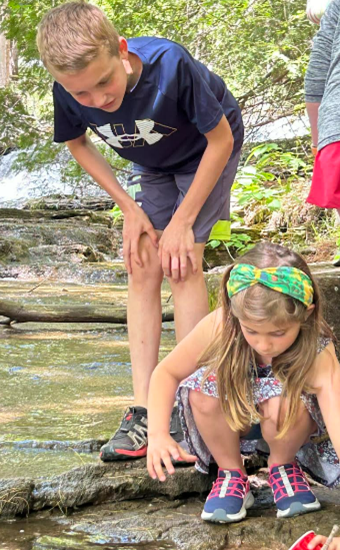
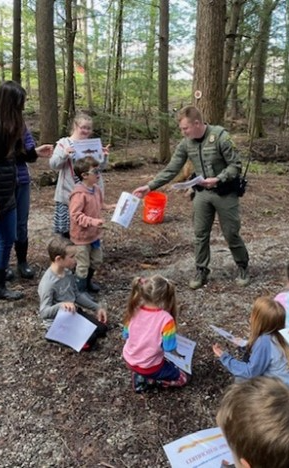
Trout in the Classroom
The Who, What, When, and Where of Release Day:
It’s Not Too Soon to Plan!
| Hello Trout Teachers,
Release Day is one of the most exciting milestones in the Trout in the Classroom year! With spring around the corner, now is the perfect time to start thinking through the logistics that can help bring your Release Day to life. Below you’ll find guidance to help you design a day that fits into your students, site, and goals. |
|
| Most schools schedule their Release Days for the last two weeks of May or the first two weeks of June. Those four weeks tend to be a time when you can count on the weather: it won’t always be sunny and dry, but it probably won’t be too cold.
You should also schedule a back-up rain date for your release day. Release Days in the rain can still be successful and fun, but a true downpour might “dampen” most people’s spirits, and days of heavy rain could lead to full, fast flowing water and pose serious risks.
A few schools are able to walk to their release sites, but most schools transport students to using school buses. If that’s the case for you, you may need to arrange your reservation ASAP and perhaps even schedule your release around the availability of transportation.
Finally, consider volunteer availability. Most schools plan Release Days that include a variety of in-stream or stream-side fieldwork activities, and enlisting the help of parents, co-workers, Trout Unlimited members, or other community volunteers may be crucial.
So, the takeaways:
- Book your buses and confirm your volunteers early.
- Schedule a back-up date.
|
|
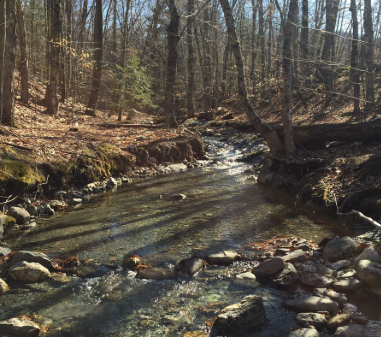
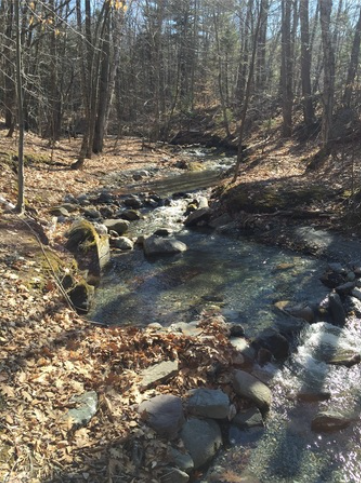
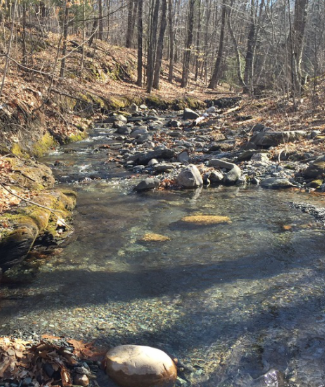
| What’s the perfect release site? I often describe it as “skinny water,” a small tributary brook that’s just big enough to support trout and the bugs that will sustain them but small enough so that nobody, not even your most over-eager young student, can get into trouble. Depending on your school’s location, you may have several fabulous release site options close by, or you may have to travel a distance for the best spot.
Here is my wish list of the ideal characteristics of a great release stream:
- A “safe” stream, three-to-six feet wide with water not much deeper than eight or ten inches.
- Adequate parking for the school bus(es) and volunteers’ cars that is close enough to safely unload, preferably without having to cross a road.
- Easy access to the stream – that is, no steep banks.
- An “assembly area” – a cleared, level stream bank, meadow, or lawn – where you can convene to give instructions, break into groups, report on what you’ve found or learned, celebrate with a snack, etc.
- Public land, or private land that you’ve been given permission to use.
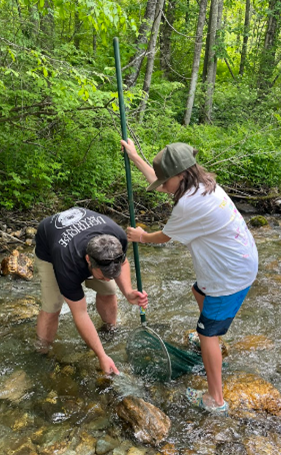
Below I’ve inserted a few pictures of streams that I consider terrific release sites. Joe Mark took all these photos on March 26th a few years ago. |
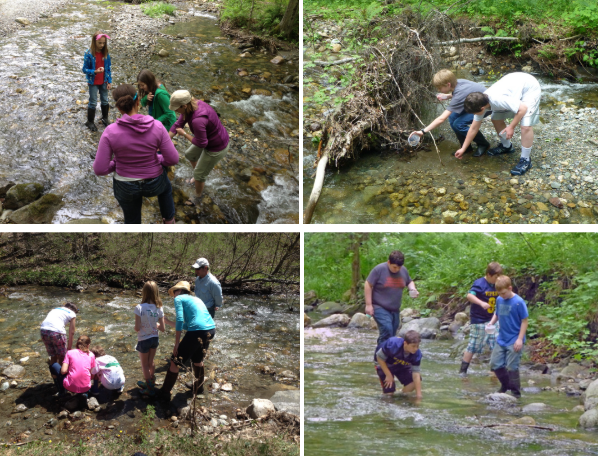
    And a few more examples of somewhat larger streams, with participants in them. And a few more examples of somewhat larger streams, with participants in them.
|
| An alternative (or addition) to scheduling a back-up day is planning a back-up site.
Because we live in a mountainous area, rain events affect waterways differently depending on elevation. At the start of a heavy rain, high-elevation mountain streams are the first to swell, while valley rivers may show little immediate change. As the storm passes, this pattern often reverses: unless the rain is truly extreme (think Irene), mountain streams tend to recede quickly, while larger rivers in the valleys remain high, muddy, and sometimes out of their banks for days. As a result, release sites that are appropriate one day may not be suitable the next—making flexibility in site selection especially important.
Finally, if you’re having trouble finding a good release location, ask for help, either from (a) stream-fishing-inclined parents or community members you know or (b) your area Trout Unlimited TIC liaison. |
Visit the Trout in the Classroom website for more Release Day Activities. Here are some things teachers have done in the past:
- Take the temperature of the stream (presumably before you release your fish)
- Test the stream’s water for pH, KH, ammonia, etc.
- Collect and identify macroinvertebrates
- Using data you gathered on various types of macros, calculate the biotic index of the stream
- Assess the riparian zone
- Inspect and classify the substrate embeddedness
- Estimate the volume of the stream at a particular point
- Estimate the speed of the stream
- Play Macro Mayhem
- Sing a trout song
- Write trout haikus
- Display your trout-square quilt
- Sketch the stream
- Eat trout-themed cake or cupcakes
|
And now, a release day video:
Depending on how ambitious your plan is for Release Day, you will probably need volunteers, some perhaps with special knowledge or skills (that’s one of the reasons I’m writing about this almost two months ahead of time). Here are some categories for potential volunteers/helpers:
- Fellow school staff members
- Parents and grandparents
- Vermont Fish and Wildlife, U.S. Fish and Wildlife, and U.S. Forest Service staff (especially for electro-fishing demonstrations)
- Trout Unlimited members
- Audubon Society members
- A local “watershed group,” e.g., White River Partnership, Friends of the Winooski River, etc. (Review the list found here to see if there is a group in your area.)
- Sportsmen’s groups, e.g., New Haven River Anglers, etc.
- The local “natural resources conservation district” — click the link then scroll down to the map and click on the district for your area to find contact information.
There are watershed groups all across the state. Are any of these rivers near your school? If so, the members of the local watershed group are very likely people who know a lot about area streams — great volunteers to recruit for your Release Day.
- Batten Kill
- Black River
- Connecticut River
- Deerfield River
- Mad River
- Hoosic River
- Huntington River
- Lewis Creek
- Missisquoi River
- New Haven River
- Ottauquechee River
- Rock River
- White River
- Winooski River
|
| How you plan your Release Day is up to you – it can be a simple affair or done with great pomp and circumstance. Enjoy it! And, as always, please reach out if you have questions.
– Jim Armbruster
Lead Biologist
Center for Field Research
Vermont Institute of Natural Science
802.359.5000 ext. 222
jarmbruster@vinsweb.org |
|
February 2, 2026
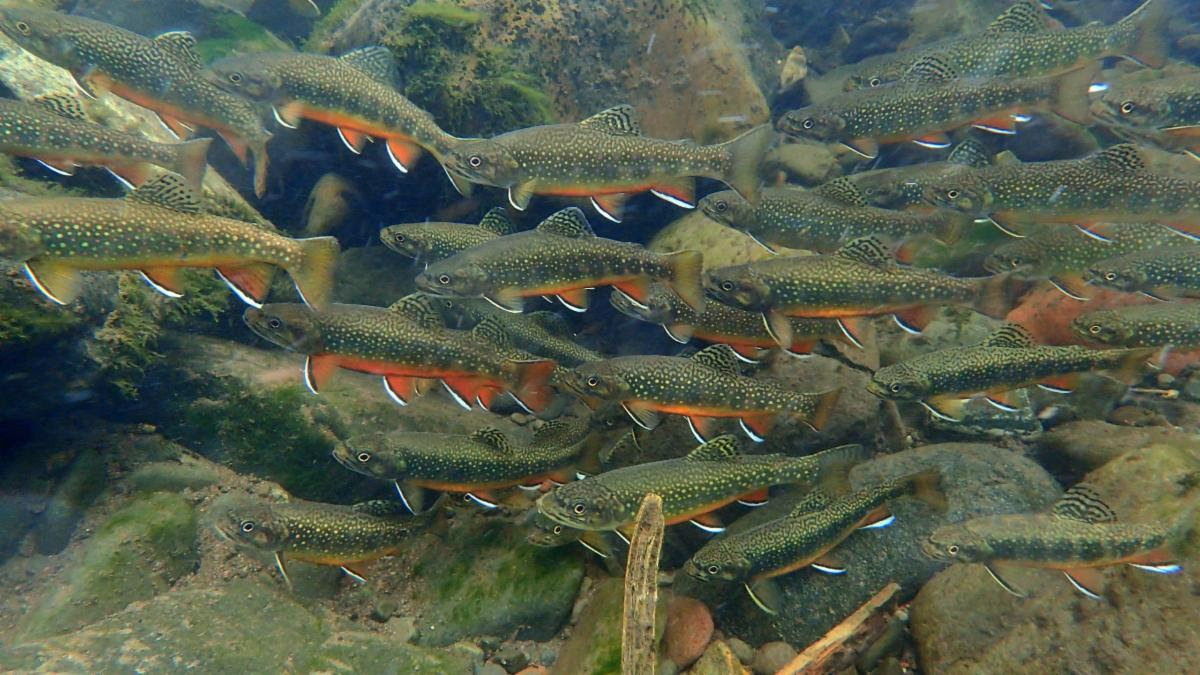 Trout in the Classroom
Hello Trout Teachers,
Your eggs have all likely hatched by now! This is a great time for students to observe alevin and yolk sacs under a microscope. Enjoy some pictures submitted by some TIC teachers:
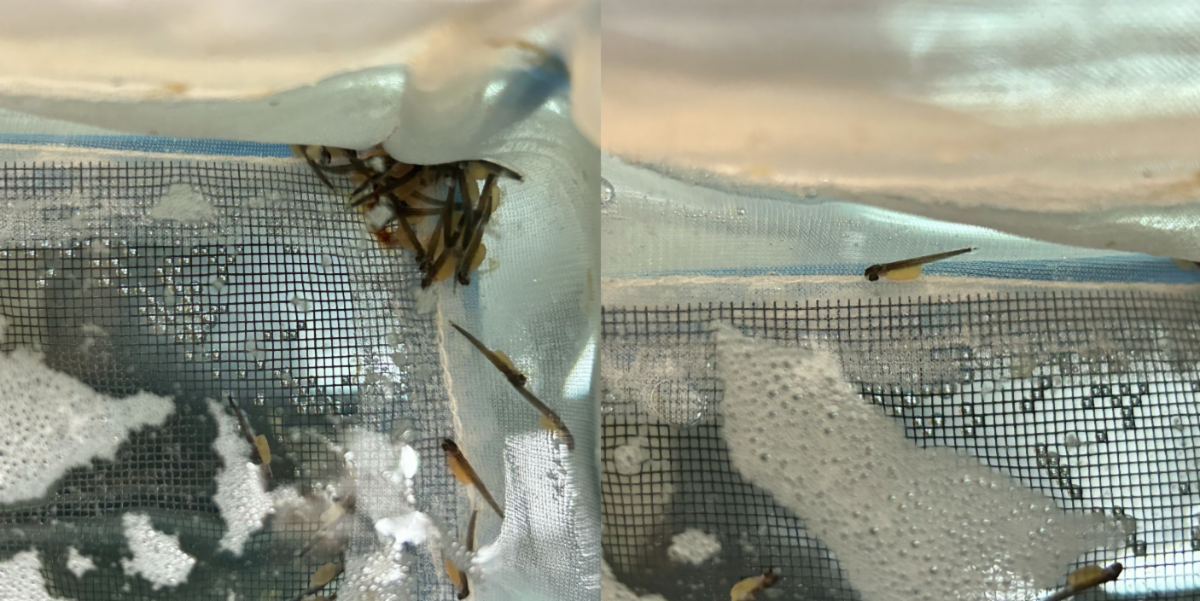 Photo credit: Siobhan Murphy
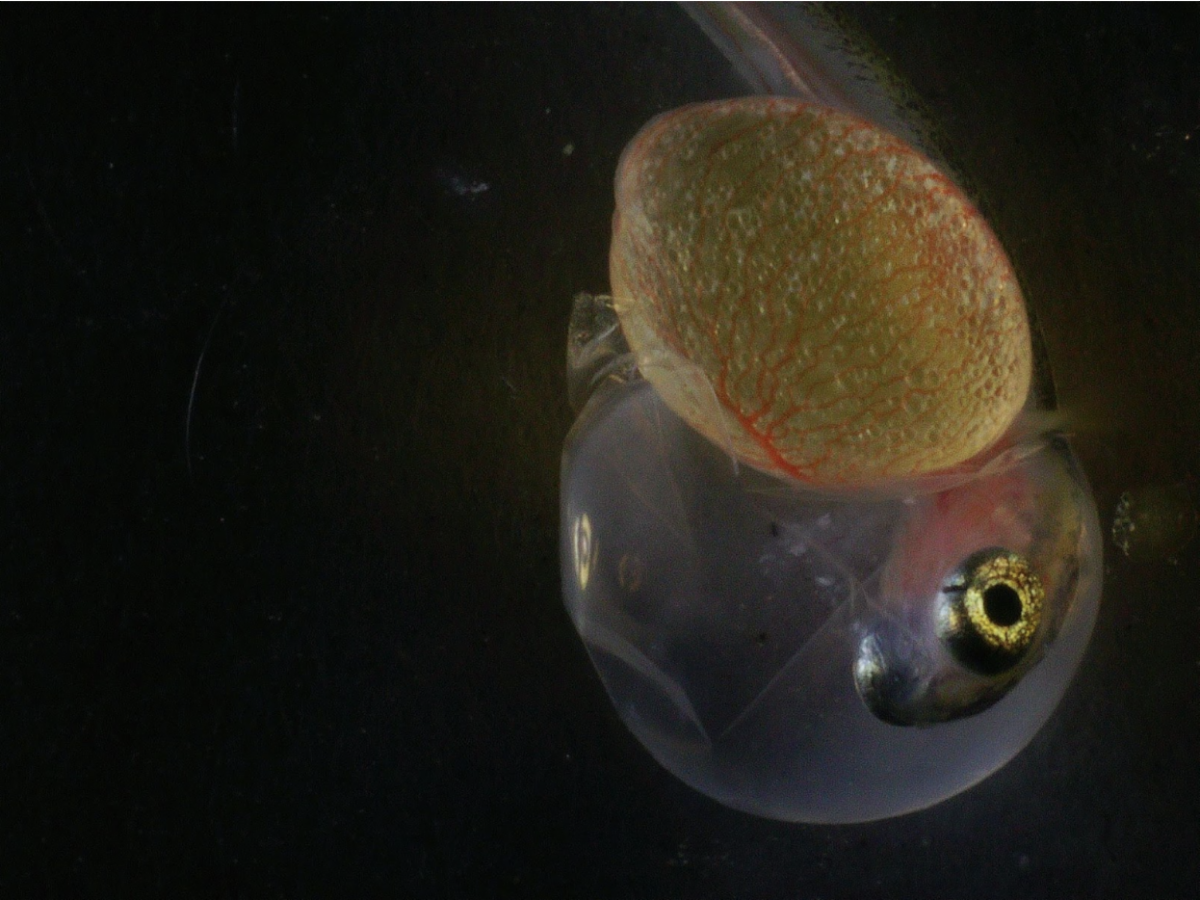
Photo credit: Sarah Kaltenbaugh
Classroom Updates
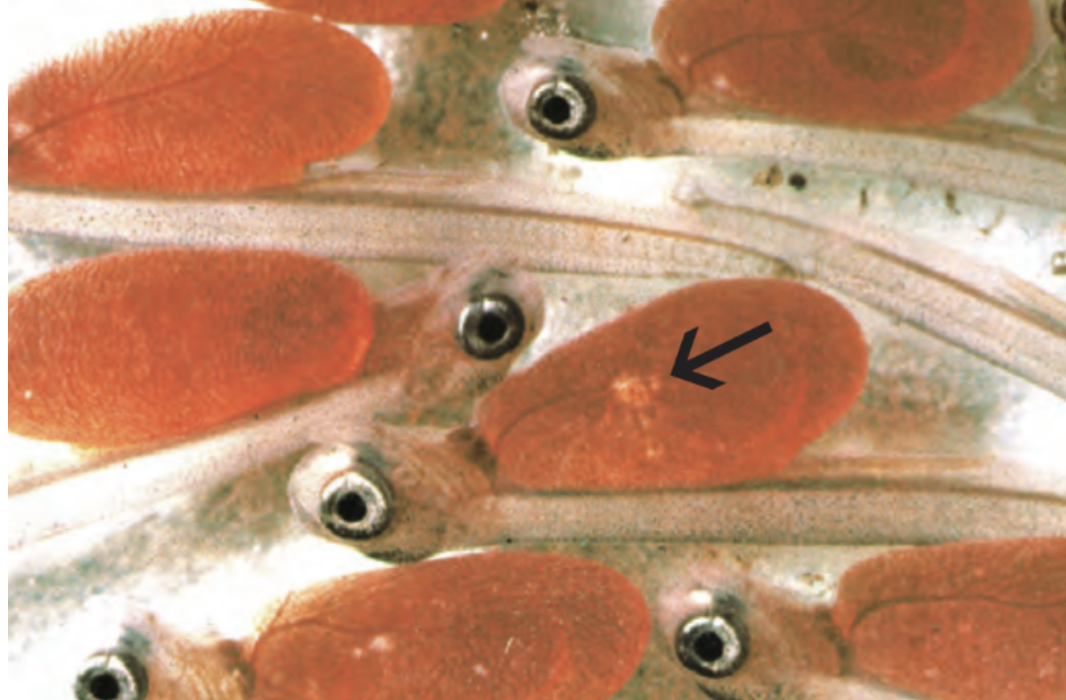 In the past there have been a few reports of coagulated yolk disease. Coagulated yolk disease presents as a white spot in the egg or yolk sac of alevin. If you have fish die from any type of disease, whether it is contagious or not, be sure to remove them from the tank so as not to spread the fungus.
| Whether you are using the cold and slow method or the warm and fast method, Swim-Up is approaching (faster, of course, for the warm and fast method). Please double check your DI Calculator to make sure you are on track with both DI and tank temperature for the method you’ve chosen. It is also a good idea to review the swim up section of the manual ahead of time to be prepared!
Here are a few tips to think about that Bob Wible shared last year:
Temperature: If the water temperature is much below 50, even if the DI is in that desired 85 to 93 degree range, there’s a high likelihood that fish might not swim up.
Light: Along with temperature, light is a key trigger of feeding behavior.
Daily (or more frequent) feedings: Once fish are ready to begin feeding, they cannot be denied! If some fish start feeding on Thursday or Friday and are not fed over the weekend, the feeding response may be disrupted. Weekend feedings are only necessary when the DI is within the target 85–93° range. After the fish have been feeding consistently for a week or more, they can safely go a couple of days without being fed.
Don’t let them out of the basket too soon! The breeder basket is small (about five inches deep); a 55-gallon tank is big (21 inches top to bottom)! Every year, some schools release their fish into the big, wide world of the tank too soon. Even fry that easily respond to food floating a few inches above them may have much more difficulty noticing food floating on the surface when it’s 20 inches away. When in doubt, keep your babies in the playpen longer – at least several weeks after they’ve all been feeding eagerly.
If you’re really itching to let them loose in the tank, try it first with just a handful of fry and see how they do. If they eat well in the big tank, then perhaps their siblings are ready to join them out there. If, however, some or all of those released aren’t reliable eaters when they’re in the big tank, try to net them and return them to the breeder basket for another couple of weeks.
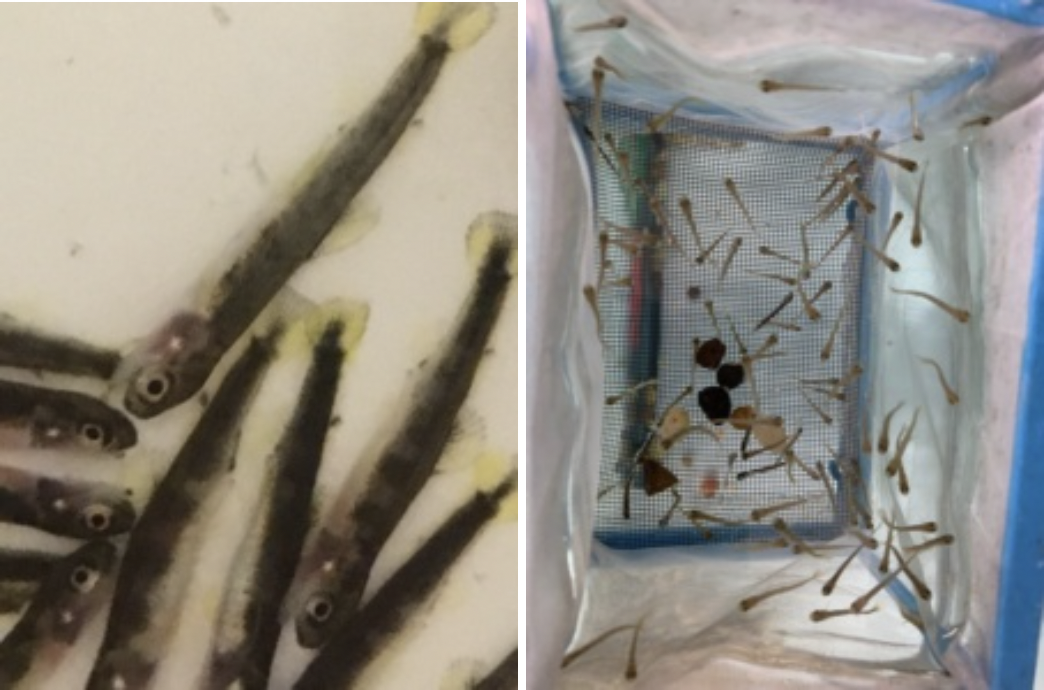
If, for whatever reason, you miss the critical window of Swim-up, you will not get a second chance and your alevin will likely become “pinheads.” Pinheads are fish that never learn to eat and instead get skinnier and skinnier until they die. Below is a close-up of some pinheads (L) and a feeder basket that has a mix of pinheads and alevin that successfully completed swim-up and are starting to feed (R). |
|
 As always, please reach out to me and/or your chapter coordinator with questions or concerns. We also love updates and pictures of tanks that are doing well!
Jim Armbruster
|
Why do we want large trees in rivers?
Check out this short video that was shared with us by a TU volunteer:
|

|
January 14, 2026
TIC Update: Eggs Arriving in January
| Hello Trout Teachers,
In early January, all across the state, Trout Unlimited volunteers and their friends delivered eggs to over 100 Vermont classrooms. Needless to say, teachers and students were excited to receive their new round little classmates.
The first few weeks of the TIC program are usually pretty quiet, but there are a couple of important maintenance tasks teachers and students need to perform.
Remove Shells and Dead Eggs
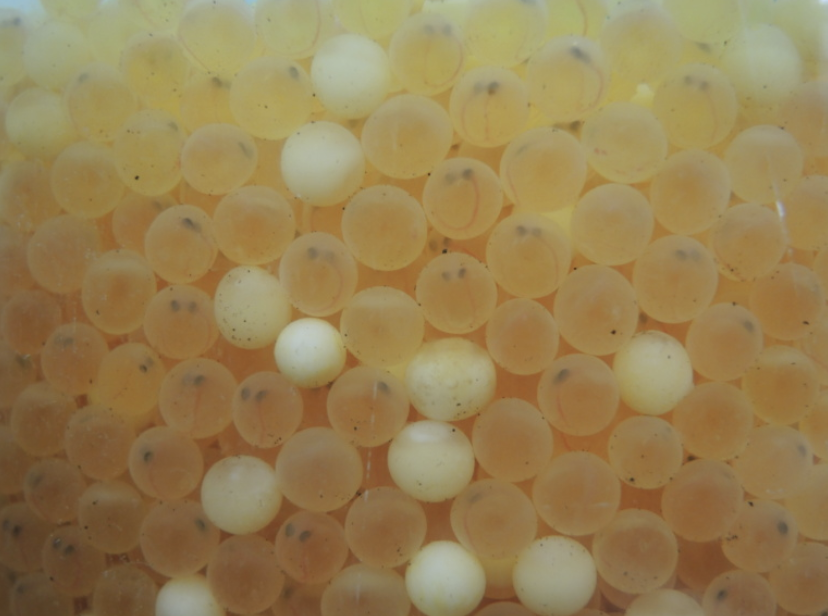
Almost certainly some of the eggs you’ve received will die. In contrast to healthy, viable eggs which are translucent and orange, the dead and dying eggs turn white, as in this photo.
It is critical that you remove and discard those or they will decay and lead to the development of fungus or mold. The same is true of egg shells left behind after your alevin have hatched; they must be removed. The best way to do this is to suck them up with a turkey baster.
Water Changes (Page 25 in the VTTIC Manual)
Water changes are one of the most important ways to manage water chemistry. Water changers, properly done, allow you to siphon out waste that would otherwise, by its decomposition, spike ammonia and/or nitrite numbers. Only elevated nitrate levels are not a problem. Anything above 1 ppm for ammonia or nitrites will require a water change. But how much water should you remove? It is all about proportions and ratios. Let’s look at an example.
Say you have a 55 gallon take, your nitrite level is at 3 ppm, and you want to get it down to 1 ppm. By removing and replacing rank water, you are endeavoring to dilute the nitrite. If you replaced ⅓ of the water in your tank – 18.3 gallons of a 55 gallon tank – with nitrite free tap water, your post-water-change nitrite level should be at 2 ppm. Similarly, if you replace ½ of your water, I’d expect your post-water-change tank to have a nitrite level of 1.5. Only if you remove and replace ⅔ of your water should you expect your nitrite level to drop to 1 ppm.
This is a great lesson for your students to learn about an authentic application of fractions, ratios, and proportions!
To do water changes efficiently, you’ll want to have two uncontaminated five-gallon buckets: one to fill with replacement water that you treat with NovAqua Plus to neutralize chlorine and other toxic metals and the other to catch the water you’ve siphoned from the tank with a hose or tube. |
|
Nitrate Levels
Nitrate levels are a lot less concerning, but many teachers over the years have used water changes to also lower nitrate levels.
In fact, the chart on page 29 of the Manual seems to imply that you should do a water change when nitrate readings reach 45 ppm.
In a blog, Joe shared an e-mail on the subject of “high nitrate” from one of the members of the national TIC/SIC discussion group. This has me rethinking our past “conventional wisdom” about nitrate management.
When dealing with your classroom teachers, please ask them what they mean by “high nitrates.” I had a teacher contact me this week who was concerned about “high nitrate” levels of 20 ppm. I assured them that a nitrate level of 20 ppm is considered low and is a non-issue for the trout in our closed-system, recirculating aquariums. The API test kits that most of us use are NOT accurate at 0-20 ppm levels of nitrate. More costly test kits are required to accurately measure nitrate at those low levels. EPA drinking water standards call for tap water levels of 10 ppm or less but in actual practice, especially in areas that use well water, we find readings of 20 ppm regularly.
Therefore, if your teacher is using tap water with a baseline level of 10-20 ppm for water changes, they never will achieve a reading of 0 ppm.
Research from the Journal of Aquacultural Engineering has shown no statistically significant difference between trout raised in 0 ppm nitrate levels versus those raised in 100 ppm levels of nitrate.
That said, I have had nitrate levels of 600 ppm on a test aquarium with no harm to my trout. Commercial closed system, recirculating trout hatcheries, recommend levels of less than 1000 ppm of nitrate…. In other words, DON’T WORRY ABOUT NITRATE LEVELS!
Troutfully yours,
Dr. Rod Berkey
AZTU, Zane Grey Chapter
Preparing for Power Outages
Here are some suggestions to help you prepare for a power outage.
- Let your custodian know that your fish will be in peril if there’s an extended power outage. Ask them to let you know if they learn that the power has gone out. Similarly, ask them to let you know when it comes back on.
- If your equipment is plugged into a GFI or GFCI (ground fault circuit interrupter; see below) receptacle, the receptacle will need to be reset if the power is interrupted even for a few seconds. There’s no way to do this remotely. Ideally your custodian or a staff person who lives close to the school will be willing to reset it for you.
- The biggest risk to your fish would be if the chiller is off for several hours. Losing the function of the filter and aerator isn’t ideal, but your fish can survive that for probably a couple of days. But if your water temperature rises too much (high 60s? 70 degrees?), you could lose all your fish. If you’re concerned that your water is getting too warm, use frozen water bottles to cool the water.
- Freeze several plastic soda bottles 80% full of tank water, treated water, or stream water. It’d be most convenient if you can keep these at school. As the one(s) you’ve put in the tank become substantially melted, replace them with thoroughly frozen ones and return the used ones to the freezer.
- Many sporting goods stores, including Dick’s and shops that sell baitfish, will carry battery-operated aerators. These can help maintain a desirable level of dissolved oxygen. They also can come in handy on Release Day.
- I know of no way to replace the function of the filter except by doing periodic water changes. You don’t need to do those unless you begin to get concerned about water chemistry levels.
Important Message from Vermont Fish and Wildlife
As a new requirement for the program, please understand that continued participation in the TIC program requires that you complete and submit the brief year-end survey administered by VINS. The Vermont Fish & Wildlife Department maintains records of all stockings that occur throughout the state to track where hatchery-raised trout are distributed to Vermont’s waterways. These records are regularly reviewed by VFWD Fisheries Biologists and serve as a reference for current and future researchers who study our wild trout populations. Given the extent of the TIC program, it is critical that information on where your school releases its fry and their number be included in this database. Thank you for bringing this wonderful program to Vermont’s youth and we wish you good luck with your project. |
|
Dec 4, 2025
Dear TIC Teachers,
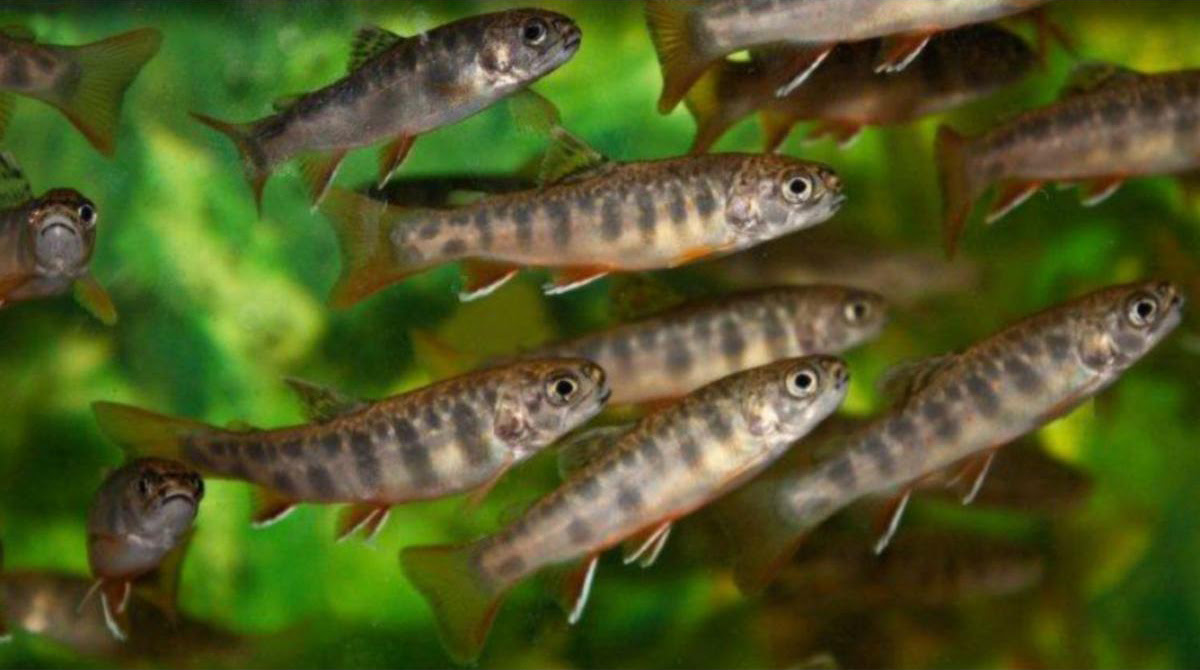
Eggs will be delivered in early January – keep an eye out for specific details from your Trout in the Classroom Coordinator. Many thanks to Jeremy Whalen and Tom Jones with Vermont Fish and Wildlife, as well as the various coordinators and volunteers who make this happen!

VINS Science Symposium
Interested in a venue for your students to share what they’ve experienced in Trout in the Classroom? Every year, VINS hosts the annual Science Symposium – a conference in May for 4th-8th Graders and their teachers. Just do what you are already doing with raising and researching trout, prepare a presentation, and bring your students in May to listen to a keynote speaker, engage in activity stations, and teach and learn from their peers. To learn more, please visit our website or email Kelly Gadouas, kgadouas@vinsweb.org.
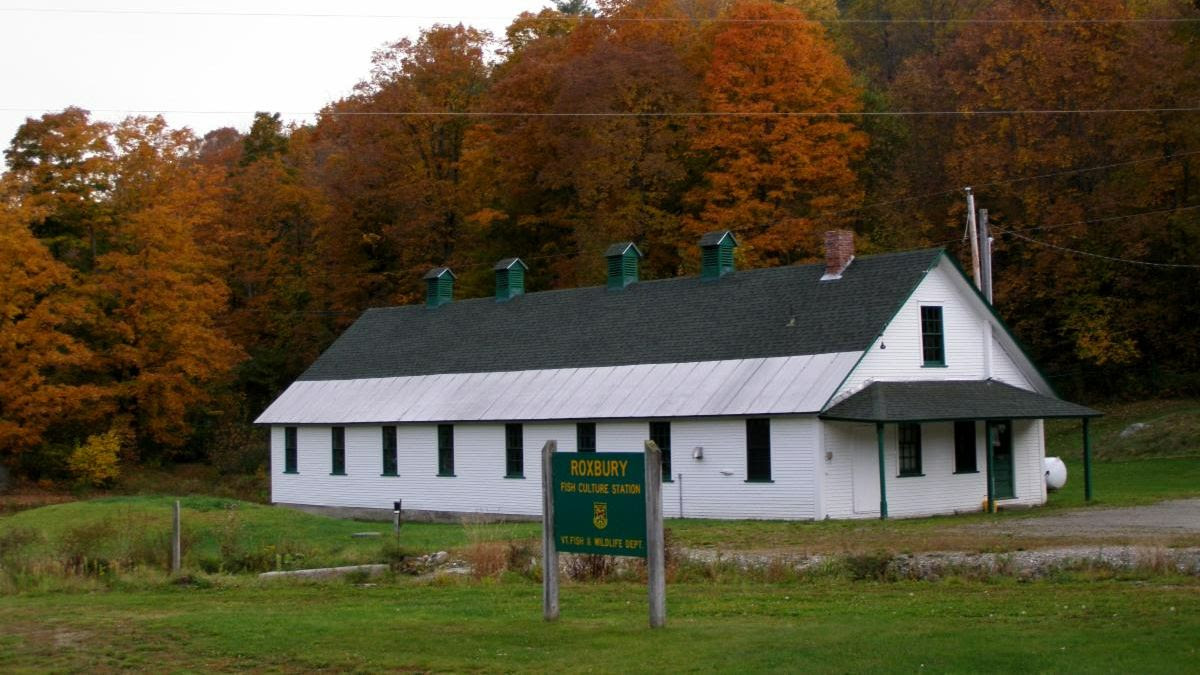 “The Roxbury Fish Culture Station is located eight miles south of Northfield, Vermont, nestled in the valley of the Third Branch of the White River. It’s Vermont’s oldest fish hatchery and is on the National Register of Historic Sites.” (https://vtfishandwildlife.com)“
Learn More: Egg Fertilization
Brook trout eggs will in the next few weeks be picked up at the Roxbury Fish Culture Station, where they’ve been under the expert care of Jeremy Whalen and his staff. But that’s not where they began their journey. You might say that they were “conceived” at the Vermont Department of Fish and Wildlife’s “broodstock facility” in Salisbury, Vermont. This kind of facility is a place where the F&W department keeps its “broodstock,” the larger males and females they use for spawning. To produce eggs for the TIC program, Salisbury hatchery staff separately collect eggs from mature female trout and “milt,” or sperm, from mature males. These critical ingredients are then mixed together. Once fertilized, the eggs were transferred to the Roxbury hatchery.
For the last few years, the Fish and Wildlife Department has been producing “triploid” eggs for our program and for much of the stocking the department does. Triploid eggs are eggs that have been modified to render them sterile. As a result, these fish can’t interbreed with native fish. Why do you think the department would want to do that?
Here’s a video of a presentation by Roxbury hatchery manager Jeremy Whalen on the subjects of the spawning process and triploids and how they are created: https://youtu.be/rzOtqH7Plf8
And here’s another YouTube video about the hatchery spawning process in the state of Pennsylvania: https://youtu.be/PnVTb5jd1p0
Connect with other teachers on Facebook
Update on Pre-Cycling
Trout Unlimited no longer recommends pre-cycling your tanks. Dr. Tim’s should only be used by those who choose to pre-cycle their tanks. You can check in with your Trout Unlimited chapter liaison for more information.
Questions? Don’t hesitate to reach out.
Best regards,
Jim Armbruster
VINS Trout in the Classroom Coordinator
November 2025
Discussion about Tank Chemistry
Start testing on Day 1! Seed it with Niteout II or Dr. Tim’s. If your water chemistry gets out of whack, you can always change the water, but well-balanced tank chemistry will reduce the need for this onerous chore. (For example, if you have to reduce a toxin by 50%, you can do this by removing and refilling 50% of the water – that’s a lot of water in a 60-gallon tank!)
Please read Chapter 7 of the manual to learn more about tank chemistry. A few notes that I took include:
- PH is the acidity. Numbers less than 7 are acidic, numbers higher than 7 are basic. 7 is neutral. Trout are fine in 7-8, but lower numbers would need adjusting.
- KH is the carbonate hardness of the water. Trout like it to be 150 parts per million, but tapwater in Vermont can be as low as 80-100 ppm. Adding baking soda can fix this (1 teaspoon per 18 points of measurement.) Learn more in Chapter 7 and Appendix E.
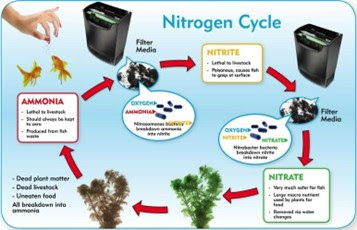
- Ammonia is the thing you should be most aware of as it high levels are fatal to fish. Ammonia is a byproduct of fish waste and has the chemical formula NH3
- Bacteria eat the ammonia and convert it to Nitrites (NO2). Nitrite levels should be below 5 parts per million in a healthy tank. The hydrogen in NH3 floats in the water and adds to acidity.
- Another bacteria consume the nitrites and convert to to Nitrates (NO3) Fish are more tolerant of nitrates, up to 40-50 parts per million. If your test strips indicate 0 parts per million (not counting the first day), this indicates that either the nitrogen cycle isn’t functioning in your tank or you need new test strips. Both should be dealt with immediately!
Things to Plan For:
- Cleaning the tank
- Tracking Temperature and Development Index (DI) every day
- Your volunteer will tell you their DI when the eggs are delivered.
- Observing fish for disease
- Power outages
- You can get battery-powered aerators at sporting goods stores
- You might have to reset things after the power comes back on
- Feeding ideas:
- You could train students to do this if they are old enough
- Write sub plans ahead of time or coordinate with a partner teacher
- Ask the custodian to feed them on vacations
- It is ok if they aren’t fed on weekends, although you could ask the custodians to do this, too.
- March Madness:
- Swim up is only about three days, but it is crucial you don’t miss it! Use the Swim Up calculator to plan ahead!
- If the Development Index is over 85 and they haven’t gone through swim up, please contact your volunteer.
- Release from Breeder Basket
- Don’t do it too soon – alevin and small fry can get sucked into the filter! Additionally, after living in the tiny breeder basket, they don’t know where to look for food in the giant tank.
- You can put mesh over the filter to prevent them getting sucked in: 15-16 holes per square inch.
- Wait a minimum of two weeks after ALL the fish are feeding to release them.
- You don’t have to do it all at once.
Resources and Ideas for Curriculum Integrations
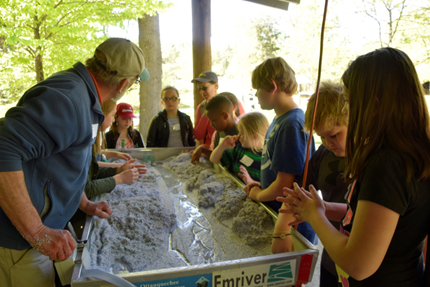
Rent the VINS Stream Table: Stream tables can realistically and dynamically simulate a wide range of river processes, including sediment transport, meander development and movement, floodplain formation, flow around structures and fluid dynamics. Rental includes set up, tear down, 2 weeks in your classroom, and a brief lesson on how to use it for teachers and students. |
|
Other Resources
- vinsweb.org > Education tab > Trout in the Classroom >Educational Resources
- Swim up Tips > Temp and DI record and swim-up calculator
- The VTTIC Manual
- Many other resources
- Macroinvertebrates.org (microscopic and larger photography) – opensource
- Whiteriverpartnership.org > get involved > teacher resources
- Waterbugs unit (low numbers this year because of flooding, recovery is about a year if healthy (messy) stream. 10 years if not)
- Trout Unlimited
- Trout in the Classroom Resources
- VTTIC Blog
- Mystery Science (if you have this curriculum)
- Why do you have to clean a fish tank but not a pond
- What would happen if you drink a glass of acid?
- Brave Little State podcast on old rivers
- If you need help for Release Day, try posting in your town listserv for community volunteers
- Facebook TIC
Check out NGSS or Common Core for curriculum integration and alignments!
- Writing:
- Journal daily!, opinion pieces, small moments…
- Students propose release location, make arguments for why their choice is better based on
- Macroinvertebrates
- Temp
- Water chemistry
- Write to sister school and/or do a quilt project
- Reading
- Many book options! But a good start is: world without fish
- Ethics and governance
- Should we stock fish?
- What are the positives and negatives of triploids (sterile trout)
- History
- The effect of clear-cutting on streams
- Science
- Labeling body parts
- Communication
- Observations
- graphing data
- dissecting trout (It’s stinky!)
- Live Zoom dissection with Tom Jones (or YouTube) – check folder
- Social-emotional
- Art
- Fly casting
Join a Facebook forum for Vermont Trout-in-the-Classroom teachers, coordinators and volunteers to support and share with one another! |
|